OMeGa: Joint Optimization of Explicit Meshes and Gaussian Splats for Robust Scene-Level Surface Reconstruction

WACV 2026 (Oral)

1Tsinghua University, China    2Beihang University, China
*Equal contribution
Teaser Image

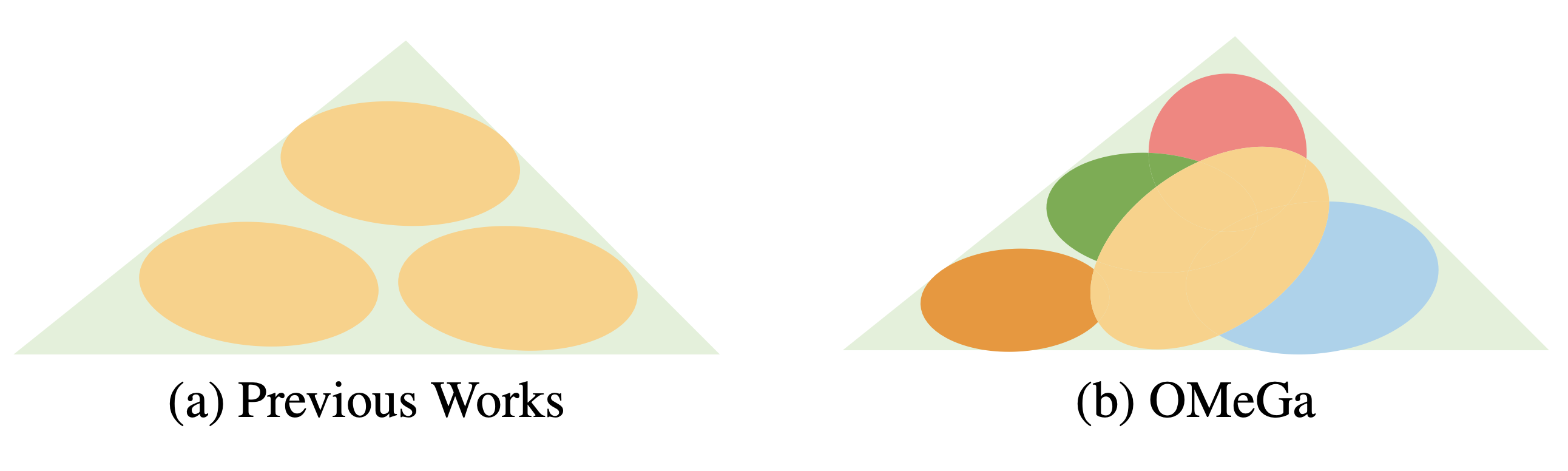
Figure 1.OMeGa jointly optimizes an explicit triangle mesh and 2D Gaussian splats, achieving high-quality scene-level surface reconstruction even in challenging indoor, texture-less regions.

Abstract

Neural rendering with Gaussian splatting has advanced novel view synthesis, and most methods reconstruct surfaces via post-hoc mesh extraction. However, existing methods suffer from two limitations: (i) inaccurate geometry in texture-less indoor regions, and (ii) the decoupling of mesh extraction from optimization, thereby missing the opportunity to leverage mesh geometry to guide splat optimization.

In this paper, we present OMeGa, an end-to-end framework that jointly optimizes an explicit triangle mesh and 2D Gaussian splats via a flexible binding strategy, where spatial attributes of Gaussian Splats are expressed in the mesh frame and texture attributes are retained on splats. To further improve reconstruction accuracy, we integrate mesh constraints and monocular normal supervision into the optimization, thereby regularizing geometry learning. In addition, we propose a heuristic, iterative mesh-refinement strategy that splits high-error faces and prunes unreliable ones to further improve the detail and accuracy of the reconstructed mesh.

OMeGa achieves state-of-the-art performance on challenging indoor reconstruction benchmarks, reducing Chamfer-$L_1$ by 47.3% over the 2DGS baseline while maintaining competitive novel-view rendering quality. The experimental results demonstrate that OMeGa effectively addresses prior limitations in indoor texture-less reconstruction.

Method Overview

Method Pipeline

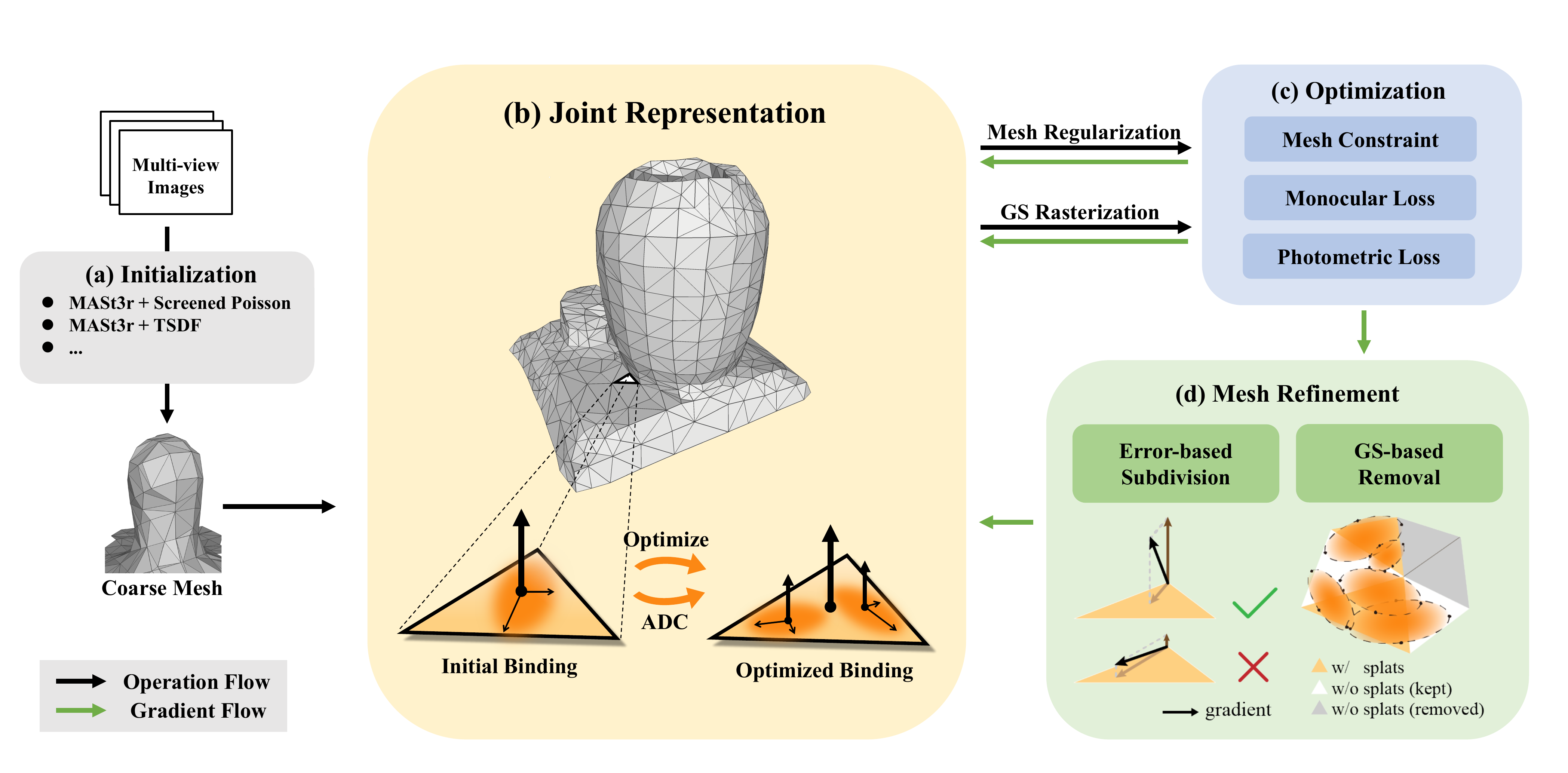
Figure 2. Overview of the OMeGa framework.

Our proposed OMeGa framework introduces a tightly-coupled optimization paradigm. The key technical contributions include:

  • End-to-end Joint Optimization: Unlike post-hoc mesh extraction methods, OMeGa directly and concurrently optimizes an explicit triangle mesh alongside 2D Gaussian splats.
  • Flexible Binding Strategy: Spatial attributes of the splats are anchored to the mesh surface, ensuring geometric consistency, while texture attributes are retained on the splats to maintain high-fidelity rendering.
  • Robust Geometry Regularization: We incorporate explicit mesh constraints (e.g., Laplacian smoothness) and monocular normal supervision directly into the pipeline to further inject geometric priors into the optimization.
  • Heuristic Mesh Refinement: A heuristic, iterative strategy that automatically subdivides mesh faces with high errors and prunes unreliable faces, dynamically adapting the mesh topology to capture fine geometric details.
Results

OMeGa achieves state-of-the-art performance on challenging indoor reconstruction benchmarks, recovering highly accurate mesh structures while delivering comparable or superior novel view synthesis results compared to previous methods.

1. Quantitative Mesh Reconstruction

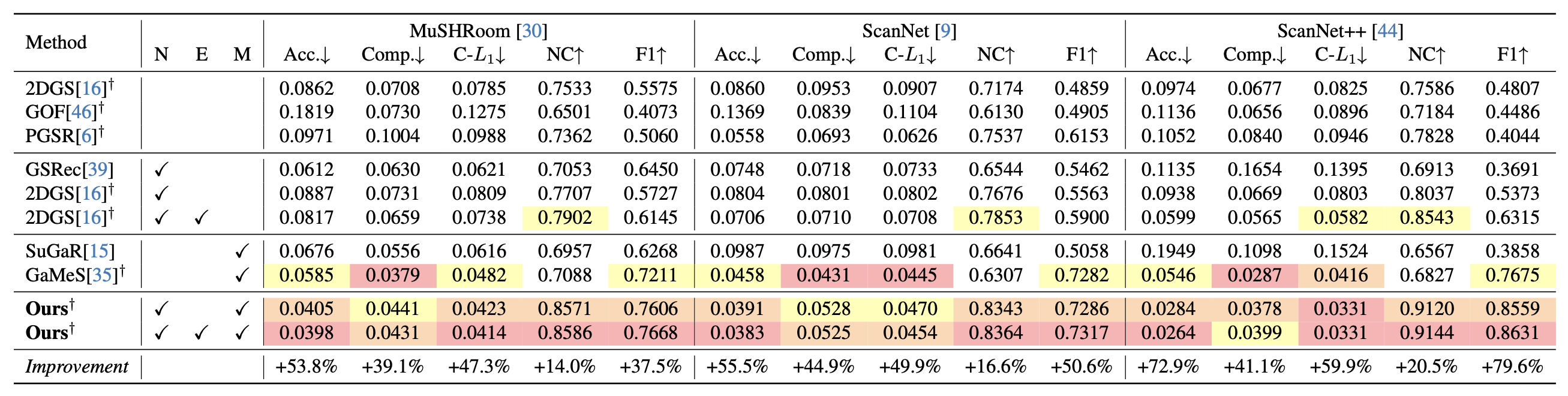
We evaluate mesh quality on the MuSHRoom, ScanNet and ScanNet++ benchmarks using Accuracy, Completeness, Chamfer Distance, F-Score, and Normal Consistency. OMeGa shows state-of-the-art reconstruction performance on all metrics.

Quantitative Mesh Results

Table 1. Quantitative mesh reconstruction comparison on MuSHRoom, ScanNet and ScanNet++.

2. Quantitative Novel View Synthesis

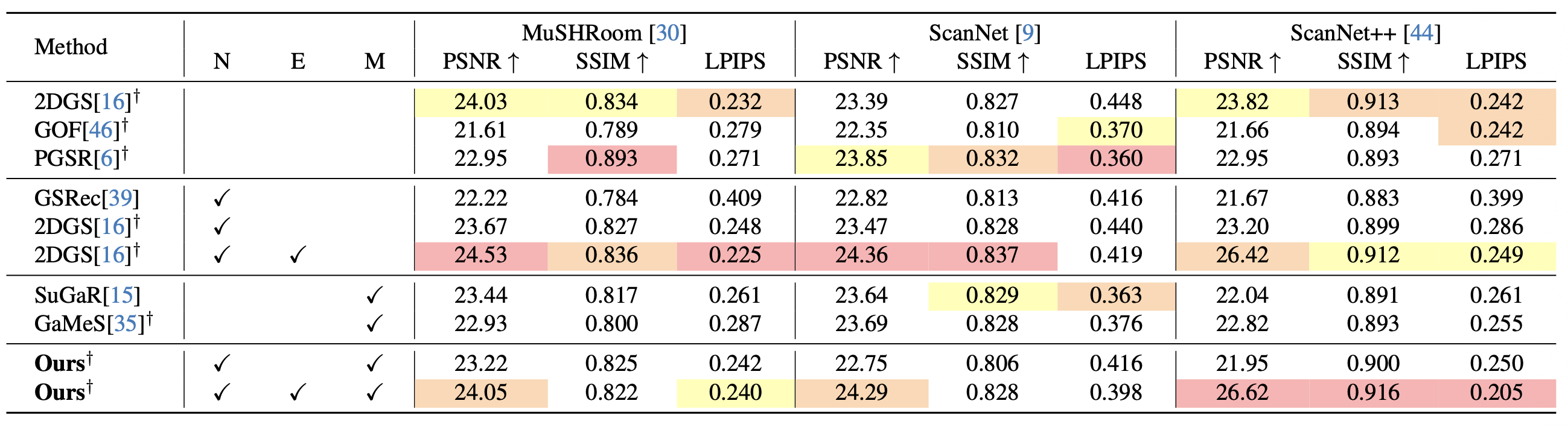
Rendering quality is evaluated using PSNR, SSIM, and LPIPS on MuSHRoom, ScanNet and ScanNet++. Despite being constrained to an explicit mesh representation, OMeGa delivers rendering quality comparable to or better than purely appearance-driven Gaussian methods.

Quantitative Rendering Results

Table 2. Novel view synthesis comparison on MuSHRoom, ScanNet and ScanNet++.

3. Qualitative Results on ScanNet++

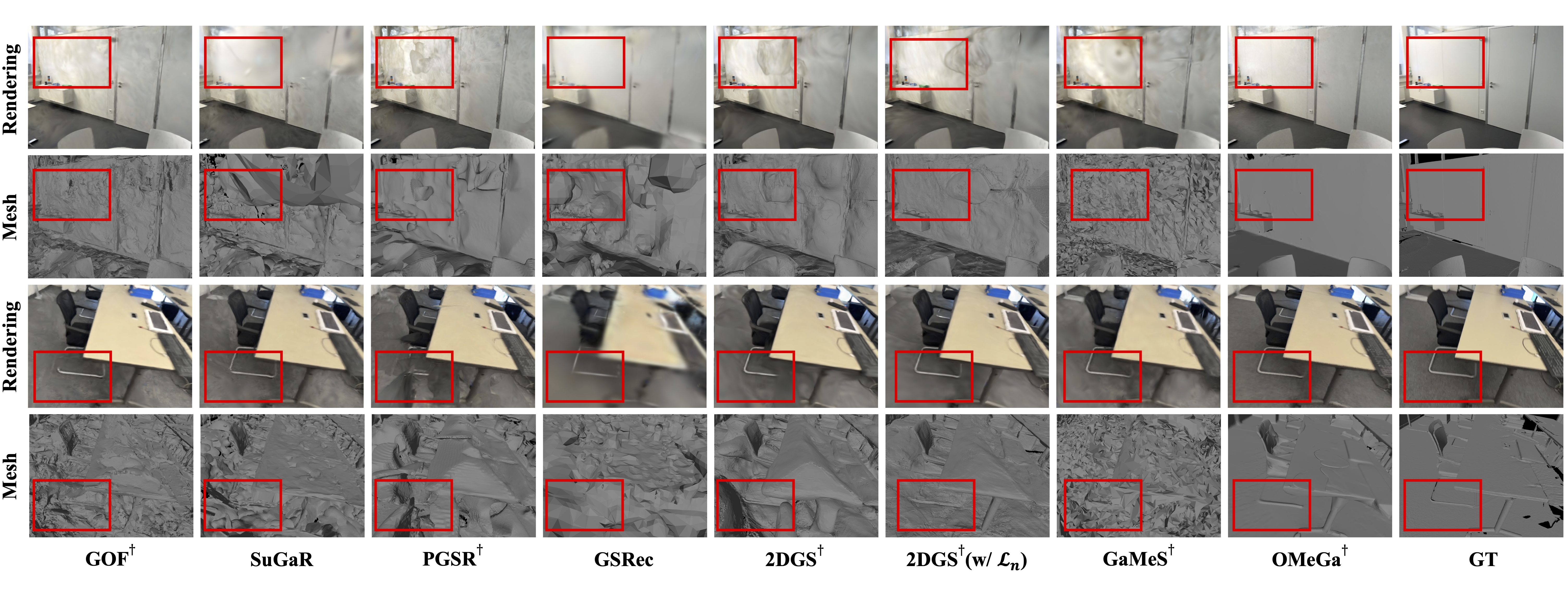
Visual comparison of reconstructed meshes and rendered images on ScanNet++ scenes. OMeGa recovers clean, complete geometry in challenging texture-less regions (walls, floors, ceilings) where competing methods typically produce noisy surfaces.

Qualitative Comparison ScanNet++

Figure 3. Qualitative comparison on ScanNet++. Each group shows the reconstructed mesh and the corresponding rendered image for OMeGa and baselines.

4. Comparison on Out-of-Distribution Views

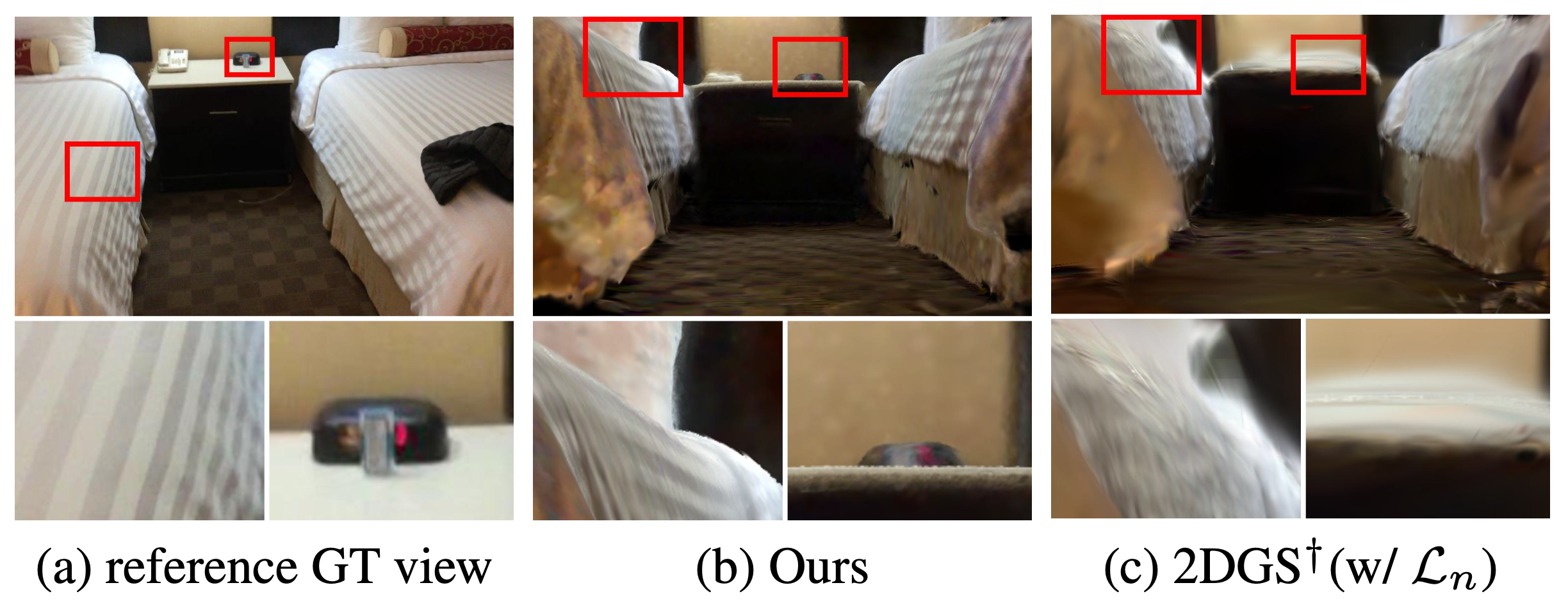
To evaluate generalization beyond standard view interpolation, we compare OMeGa with the baseline 2DGS on camera viewpoints that deviate significantly from the training trajectory. While vanilla Gaussian Splatting methods often overfit to appearance within the captured distribution, they struggle to maintain coherence in unseen territory, leading to blurry artifacts. By anchoring Gaussians to an explicit mesh, OMeGa enforces rigorous structural consistency through mesh-derived geometric guidance. This enables high-fidelity rendering even for out-of-distribution poses where robust geometric priors are essential.

OOD View Comparison

Figure 4. Comparison on out-of-distribution views. OMeGa renders more geometrically consistent novel views while baselines exhibit significant artifacts and blurring on out-of-distribution viewpoints.

BibTeX

@article{cao2025omega,
      title={OMeGa: Joint Optimization of Explicit Meshes and Gaussian Splats for Robust Scene-Level Surface Reconstruction},
      author={Cao, Yuhang and Yan, Haojun and Yao, Danya},
      journal={arXiv preprint arXiv:2509.24308},
      year={2025}
    }